


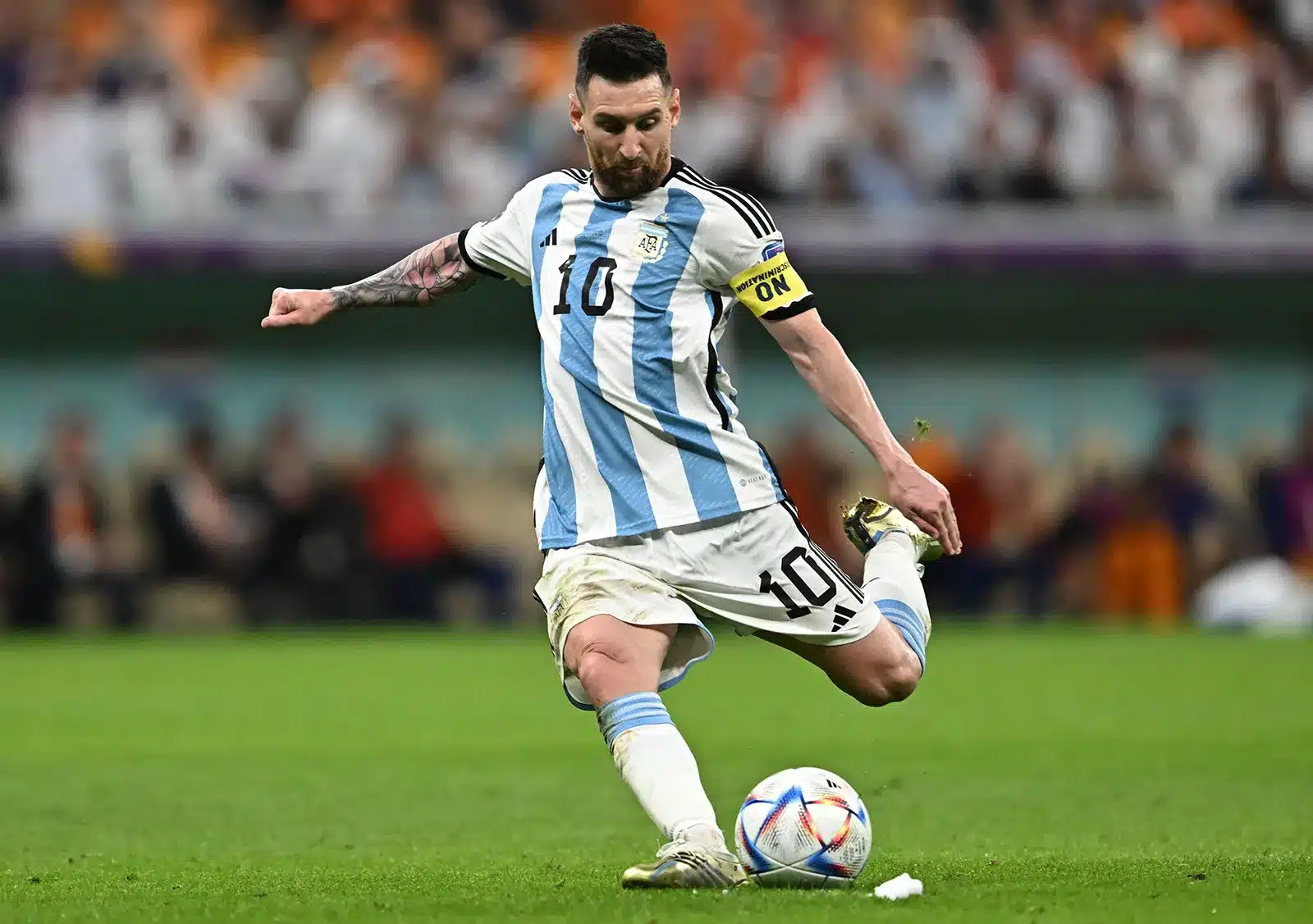
Will Lionel Messi score the next goal?
Unbeaten but winless, the World Cup debutant has advanced to this Argentina vs. Cape Verde match. The Cape Verdean islands’ World Cup fairy tale is writing another chapter, with the defending champions set to be the next team added to the story of their historic first World Cup appearance. As has been the case in all previous matchups, the Blue Sharks are the underdogs in our Argentina vs. Cape Verde prediction—a label that head coach Bubista and his players can’t escape, even in the AI analysis.
Even before kickoff, this matchup seems like a drastic mismatch. On one side: the defending champions and the world’s number one team. On the other: an island nation with about half a million inhabitants, a World Cup debutant that just a few weeks ago was considered a romantic side story and is now in the knockout stage as the smallest country in World Cup history.
And yet, despite the lopsided Argentina vs. Cape Verde odds, this matchup can be more than just a favorite versus an underdog. It’s one of the most beautiful storylines of this tournament. Lionel Messi takes on Vozinho; the reigning world champions are put to the test by the “miracle team”; and expectations clash with faith.
Cape Verde hasn’t won a single game in this World Cup. But they haven’t lost one either. Three games, three draws, two shutouts, second place in a group with Spain and Uruguay. That sounds absurd. And that’s exactly why it fits this team and the 2026 World Cup.
Argentina vs. Cape Verde AI Prediction
However, compared to the bookmakers’ odds, the win rate for Lionel Messi and his teammates on the Argentine national team drops to below 80 percent. In contrast, the Argentina–Cape Verde AI prediction calculates a 14.5 percent probability of a draw. This represents a small value of just over two percent.
Argentina – Statistics & Current Form
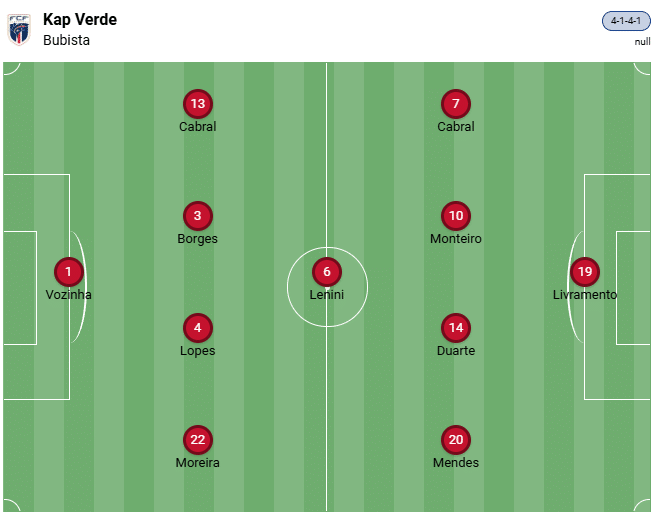
Argentina played through the group stage just as defending champions like to play: confidently, in control, and without suffering any major setbacks. Lionel Scaloni’s squad gave the impression that they still had reserves to draw on at any time. It all began with a one-of-a-kind Messi night. In their opener, the now 39-year-old scored a hat trick in a 3-0 victory over Algeria. Once again, it became clear: the Albiceleste revolves around its longtime star and yet doesn’t seem outdated. Perhaps their most telling victory came next, against Austria.
Ralf Rangnick’s team brought intensity, pressing, hard work, and that collective energy that can usually pull any team out of its comfort zone. Argentina wasn’t fazed by it. Scaloni’s team found short passing lanes in tight spaces, drew Austria’s pressure toward them, and then shifted the play into open areas.
Messi scored twice, but the performance spoke volumes beyond just Messi. It spoke of a team that knows how to handle pressure. In the final group stage match against Jordan, Scaloni made extensive lineup changes. Messi started on the bench—yet Argentina still won 3–1. Giovani Lo Celso scored on a free kick, Lautaro Martinez converted from the penalty spot, and Messi, who came on as a substitute, also found the net in the third group stage match—on a free kick.
The World Champions Look Ready
Lionel Messi already has six tournament goals to his name—bringing his total to 19 World Cup goals throughout his career. The captain has maintained his exceptional skills and style of play. He has scored in seven consecutive World Cup matches. Will the prediction of another goal from this exceptional player come true in the match between Argentina and Cape Verde?
This is no longer just a matter of form. It’s a late chapter in soccer history that seems to be watching itself unfold. Nevertheless, it would be wrong to view the Albiceleste solely through the lens of Messi. This team’s strength lies in its balance and its willingness to collectively compensate for the defensive shortcomings of an aging superstar.
Everyone accepts their roles, and the tournament bracket is kind to the defending champions. First up is Cape Verde, followed by Australia or Egypt, and later possibly Colombia or Switzerland. On paper, Argentina’s path to the semifinals is more favorable than that of many other favorites.
Cape Verde – Statistics & Current Form
If FIFA was looking for a story to justify an inflated tournament format, it has found one. Of course, one can debate the merits of 48 teams, statistical calculations, and disparities in quality. But then a nation like Cape Verde comes along and reminds us why World Cups aren’t just about the favorites.
Even the first match against Spain was one of those nights when the statistics and the final score hardly seem to match. Spain had possession (65.7 percent), took shots (27), delivered crosses (39), and was present in the final third almost the entire time. Cape Verde had Vozinha, discipline, a clear structure, and that special tournament spirit that turns a seemingly one-sided match into a test of resilience.
The 0–0 draw against the European champions wasn’t just a nice footnote—it was the foundation for everything that followed. Things got wilder against Uruguay. The Blue Sharks fell behind, fought back, came under pressure again, and still managed to salvage a 2–2 draw. Once again, it wasn’t a clean game. Once again, there was no dominance. But once again, they put up a fight.
Can Cape Verde make this a tight game again?
The tactical question is clear: Can Cape Verde keep this game at 0–0 for a long time? If so, the intensity will change. Argentina will have possession but won’t necessarily rush the play. Scaloni knows that knockout matches don’t have to be won in the first quarter-hour.
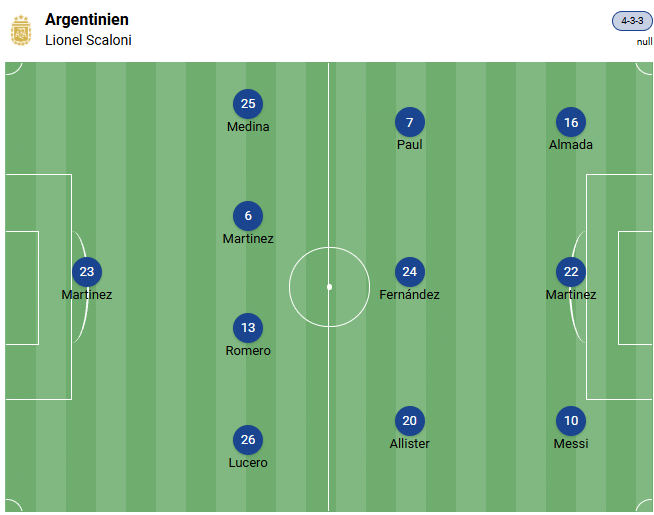
Cape Verde will have to defend deep, likely in a compact 4-1-4-1 or 4-5-1, with tight spacing in the center and a lot of attention on Messi between the lines.
Against Spain, that was the crucial space: not just the back line, but the zone in front of it. Messi must not be allowed to run wild there—easier said than done.
Because Argentina lures opponents in, plays short combinations, and then looks for the moment when Messi becomes unmarked on the far side or at the edge of the penalty area. Austria had to learn this the hard way—as did Jordan. And even if Messi seems to disappear for minutes at a time, all it takes is a free kick, a run into the box, a through ball, or a feint to dash any hopes of an upset victory in the match between Argentina and Cape Verde.
Argentina – Cape Verde Head-to-Head Record
For Cape Verde, therefore, it’s not just defense that will be crucial in this first head-to-head matchup, but also relieving the pressure. If every ball comes right back, the pressure will eventually become too much. The World Cup debutant must remind the defending champion that this match isn’t a one-sided affair. But is that realistic?
Argentina vs. Cape Verde Prediction
La Albiceleste has played seven international matches since the start of the year. Lionel Scaloni has already celebrated seven wins this calendar year. In four of those seven matches, the three-time World Cup champions scored three or more goals—twice, Lionel Messi and his teammates managed over 2.5 goals in the World Cup group stage.
The defending champions are entering the knockout stage in top form and have not, so far, given the impression of a team that underestimates its opponents—even when playing the underdog. Furthermore, only Norway (0.19 xG/shot) has created higher-quality scoring chances on average in this tournament than Argentina (0.17 xG/shot).
Scaloni’s squad has consistently shown good balance in their play so far, offered a variety of solutions, and has a world-class playmaker in Lionel Messi—even at the age of 39. The Albiceleste also rarely runs out of patience, so we expect a comfortable victory for the favorites.

