


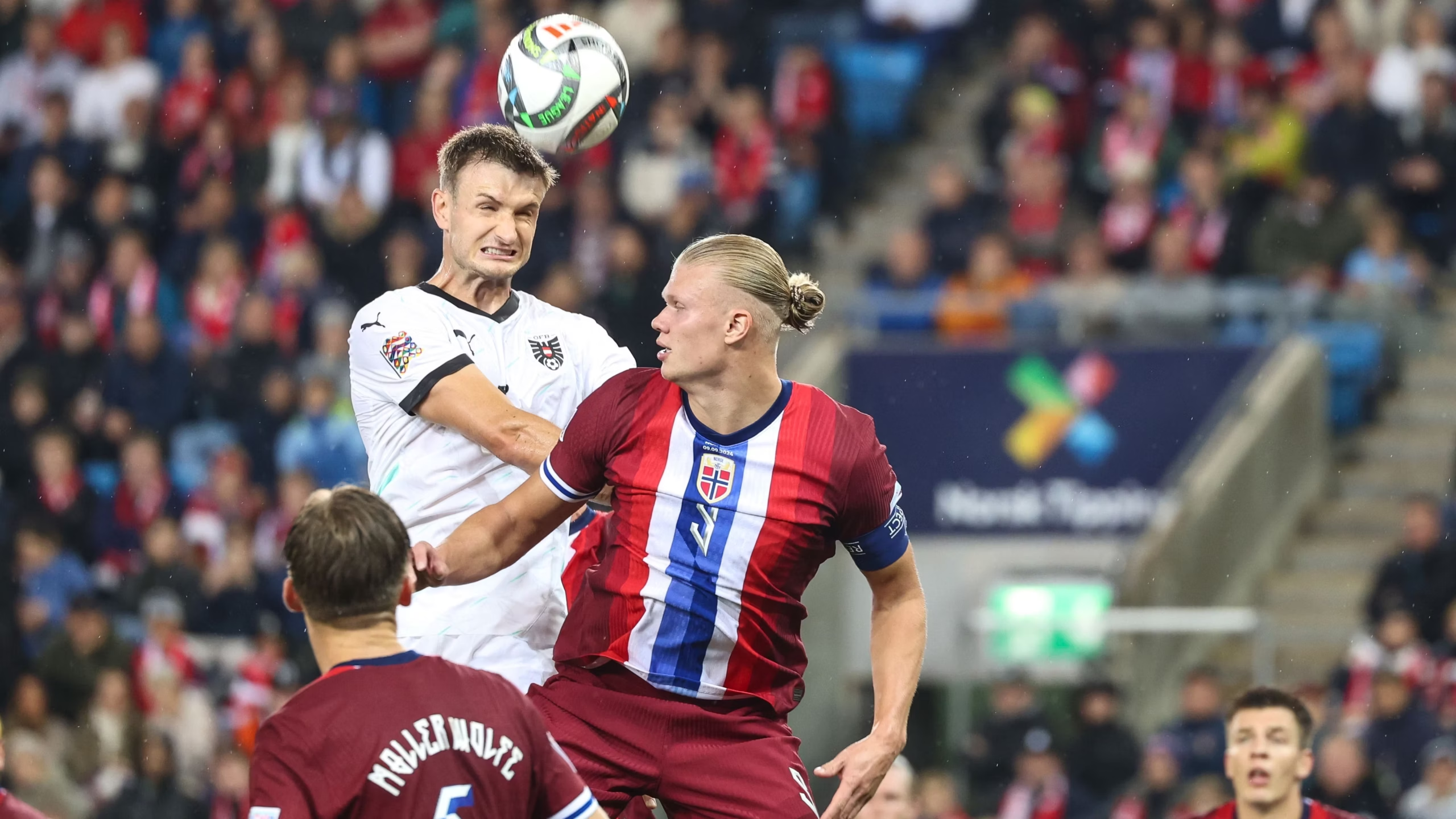
Will the game be decided on the wings?
The Seleção breathed a sigh of relief, while the Lions kept pushing forward. Two scenes from the Round of 16 lead directly to our Brazil vs. Norway prediction. In Houston, the record-holding world champions managed to turn a dangerous match against Japan into a 2-1 victory late in the game. In Dallas, Norway’s team sat on the field in front of their fans after their 2-1 win over Ivory Coast. Martin Odegaard beat the drum, Erling Haaland grinned, and the “Viking Row” became a symbol of the tournament. The World Cup has long been historic for Norway, and according to our Brazil vs. Norway prediction, the joy could continue into the Round of 16 at the 2026 World Cup.
Norway is competing in its first World Cup finals since 1998. For the first time ever, the Lions won a knockout match at a World Cup in the Round of 16 against Ivory Coast. Stale Solbakken’s squad is led by several brilliant professionals.
Martin Odegaard, Antonio Nusa, and, of course, Erling Haaland are the most prominent players on this team, but they are by no means the only talented players on the Northern European squad. Brazil is in for a physical battle in which the Seleção’s defense will be put to the test. Nevertheless, the bookmakers’ Brazil vs. Norway predictions make it clear who the favorite is.
On average, the Norwegian national team’s potent offense has averaged 2.08 expected goals per game in this World Cup tournament. This figure even includes the 1-4 loss to France, in which Stale Solbakken made changes to ten positions in his starting lineup.
Brazil vs. Norway AI Prediction
The Brazil vs. Norway AI prediction sees a slight edge for the record-holding World Cup champions, who emerge from the simulations with a 48.8 percent probability of winning. Overall, the AI projects 2.96 expected goals for this Round of 16 match and gives us a clear “go” for a bet on “Over 2.5 Goals.”
Brazil – Statistics & Current Form
Anyone who has watched Brazil in this World Cup won’t recognize the classic Seleção from commercials and old memories. This team isn’t built for constant flair. It’s more pragmatic, more patient, and at times even matter-of-fact. That’s precisely Ancelotti’s signature style.
This style was particularly evident against Japan. Brazil trailed 0–1 at halftime, struggled with Japan’s pressing, lost possession while building up play, and looked too sluggish in midfield. Kaishu Sano capitalized on a mistake by Danilo, ran past Casemiro, and put the Samurai Blue ahead.
It was a moment that exposed the Selecao’s weaknesses: age and lack of pace in defense, risk-taking in build-up play, and a lack of control against an opponent that boldly applies pressure. But Ancelotti reacted. Lucas Paquetá had to come off due to injury, Endrick came on—and the record-holding world champions effectively shifted to a much more offensive structure.
No romance, but solutions
Vinicius Junior and Rayan held the width. Brazil played more directly, brought more players into the box, and forced Japan deeper. A tough-fought game turned into a high-pressure match. The equalizer fit the bill: Gabriel Magalhaes crossed, and Casemiro headed it in at the far post. Not pretty in the classic Brazilian sense, but effective.
Later, Gabriel Martinelli—actually a winger—came on in a more central role and, in the 96th minute, was exactly where a striker needs to be. Bruno Guimaraes found him, Martinelli scored, and Brazil advanced. While everyone erupted, Ancelotti remained calm.
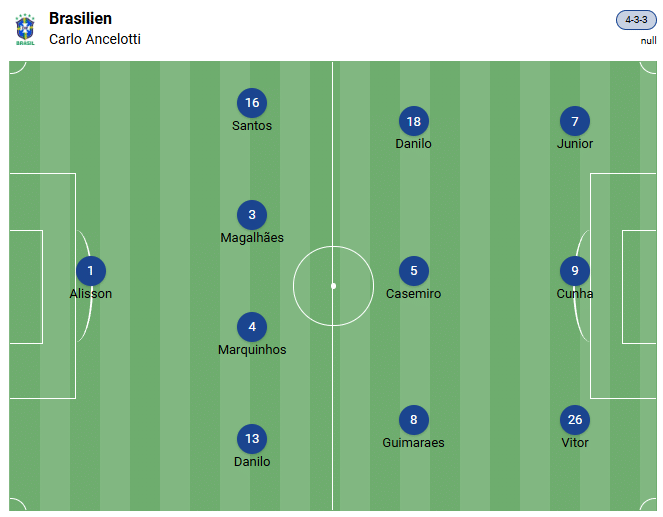
This scene says a lot about this Seleção. Under him, Brazil doesn’t win because it’s constantly over-the-top, but because it can weather the storm. When they fall behind, these ambitious South Americans don’t fall apart. They can rely on their coach, who finds simple, clear solutions. As things stand, Brazil enters the Round of 16 with the best expected offense in this World Cup tournament (2.35 xG/game). This team is dangerous—but not invincible in the Brazil vs. Norway match.
Norway – Statistics & Current Form
Norway has already shown several different sides of itself in this World Cup. Against Iraq, the team won 4–1 and looked like a squad capable of combining its offensive firepower with possession play. The match against Senegal was wilder, more open, and more dramatic—but also successful (3–2).
We can easily brush aside the 1–4 loss to France—the extensive rotation makes it much harder to draw analytical conclusions. Norway wasn’t consistently the better team throughout their Round of 16 match against Ivory Coast. However, the Lions were there with maximum precision at the decisive moments.
Erling Haaland’s immense quality allowed the striker to fade into the background for long stretches of the match against the Ivorians—he was barely visible. Then came the moment: Oscar Bobb opened up space, Patrick Berg crossed the ball, Haaland was unmarked, and he tapped the ball over the line. It wasn’t a spectacular finish. But that’s exactly what makes him so typical. Haaland doesn’t care what a goal looks like. He only cares that it goes in.
More than Haaland—but always with Haaland
His stats for Norway are absurd: 60 goals in 53 international matches, five goals at this World Cup, each one on first touch. He’s not a striker who needs a lot of moves. He’s the finishing touch. A threat that looms over the field for 90 minutes. But Norway isn’t just Haaland. That’s important.
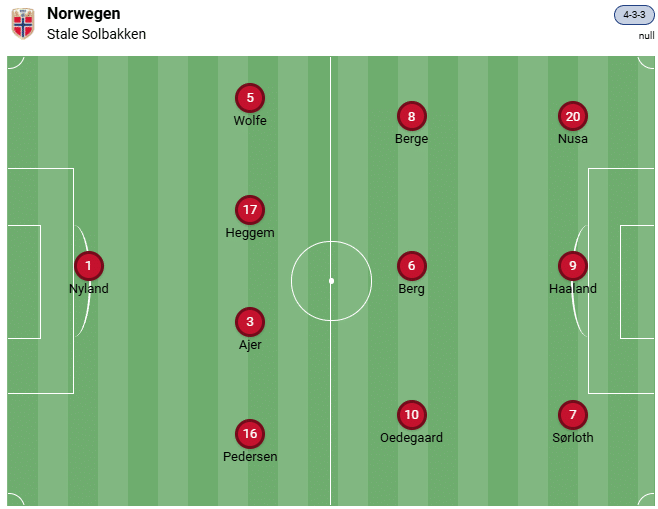
Martin Odegaard is the playmaker, even if he sometimes looks for Haaland almost too much.
Antonio Nusa brings speed, dribbling, and finishing ability on the left. His goal against Ivory Coast was a classic inverted winger moment: cutting inside, opening up his body, and finishing into the far corner.
Alexander Sorloth isn’t a classic winger on the right, but rather a second target man who adds physical presence to Norway’s attack. Norway can get into the box in several ways. Options include crosses, through balls, and dribbles. The average chance quality (0.19 xG/shot) shows that many of these routes lead to promising scoring opportunities. Against Brazil, the odds appropriately list Norway as the underdog, but not as having no chance.
Brazil – Norway Head-to-Head Record
Historically speaking, the Seleção is facing a team it has long feared. There have been four head-to-head matches between the two nations—the first on July 28, 1988. The South American team has not won a single one of these matches. In addition to two draws, Brazil suffered two losses—in both instances, the Seleção conceded two or more goals.
Brazil vs. Norway Prediction
Of course, there will be a lot of talk about Haaland versus Gabriel Magalhães. Both know each other from the Premier League, and neither is exactly known for holding back in physical duels. Haaland versus Gabriel and Marquinhos is the most high-profile matchup of this Round of 16.
But it would be too simplistic to reduce the game to just that. Brazil has to defend against more than just Haaland. Brazil must prevent Norway from even getting into the kinds of situations that Haaland can capitalize on. That means: putting pressure on Odegaard, keeping a close eye on Nusa, and maintaining tight marking on Sorloth at the far post.
Japan has shown that Brazil can make mistakes under pressure. Morocco had already hinted during the group stage that dynamic, bold opponents can find space. Norway is dangerous in this regard because it doesn’t need many chances. Against Ivory Coast, nine shots were enough for 2.3 expected goals. That’s an indication of the quality of the opportunities Solbakken’s team creates. Despite the Brazil vs. Norway betting odds, the Norwegians are a tough opponent who run a lot, believe in their own abilities, and attack with clear patterns.

