


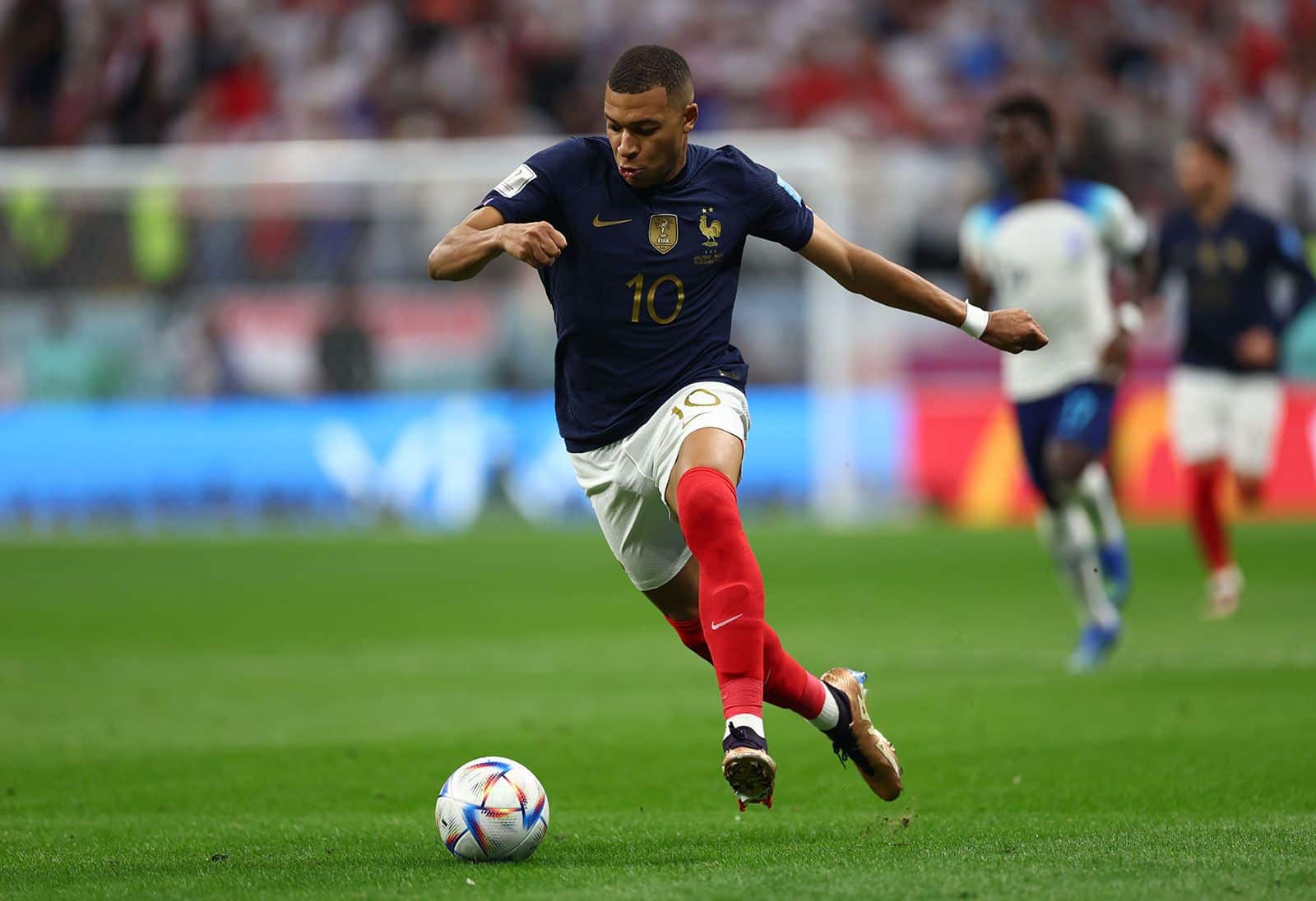
Will Harry Kane take the World Cup stage for the last time?
The third-place match is the strangest fixture on the World Cup calendar, and yet the France vs. England prediction is by no means meaningless. It’s not a final, but it’s not just an ordinary placement match either. It’s a consolation prize with medals. A final TV appearance, a final stage for statistics, farewells, and open wounds await the players from both national teams in the France vs. England prediction.
For these two ambitious national teams, this match in Miami comes at a particularly complicated time—both nations believed they were well on their way to the final. France and England have left their mark on the tournament long enough not to be simply dismissed as failures. And yet neither is traveling to New York for the final, but rather to Florida for the bronze medal match.
The Equipe Tricolore lost 0–2 to Spain and, for the first time in this World Cup, didn’t look like a team everyone had to fear. Unlike the French, Thomas Tuchel’s team actually took the lead against Argentina and was 35 minutes away from its first World Cup final since 1966. But Lionel Messi and his teammates applied increasing pressure, perhaps also benefiting from the Three Lions’ increasingly defensive approach.
That’s what makes this matchup interesting. Not because third place is the big dream. But because it shows how two great soccer nations deal with disappointment. The tournament so far has shed light on the strengths of both medal contenders and points us toward a goal bet. Didier Deschamps and Thomas Tuchel generally opt for limited risk and value control of the game.
France vs. England AI Prediction
The AI has France in its sights when it comes to victory. With a 43.6 percent probability of winning after 90 minutes, the Equipe Tricolore is considered a clear favorite over the English (30.1%). According to the calculations, the chance of a draw stands at 26.3 percent. When it comes to advancing after 120 minutes or in a penalty shootout, the French are even favored at 58.6 percent. It remains interesting to note that France conceded goals in the knockout stage only in their semifinal loss to Spain and, overall, in just two group stage matches. That’s why we’re going with “Both Teams to Score: No.” At Interwetten, the odds of 2.85 correspond to a probability of just 35.09 percent, while the France vs. England AI prediction shows clear value at 40.7 percent.
France – Statistics & Current Form
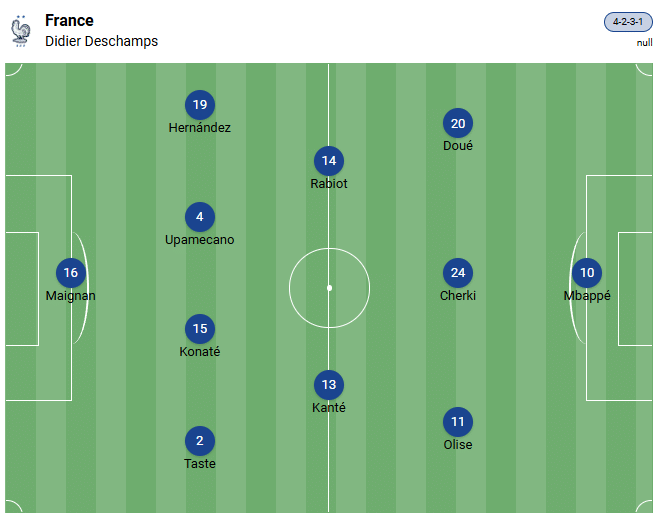
For much of this tournament, the French were the team known for speed, individual brilliance, and offensive firepower. Kylian Mbappé, Ousmane Dembélé, Michael Olise, and Bradley Barcola had overwhelmed opponents at times.
On his farewell tour, Didier Deschamps seemed to have once again found a team capable of combining his pragmatic tournament approach with spectacular offensive quality. Then came Spain. The 0–2 loss in the semifinals wasn’t just a defeat. It was a crushing blow.
France couldn’t find its rhythm, couldn’t get a foothold, and lacked any real punch. Mbappé failed to make a decisive impact, Olise was neutralized, Dembélé fizzled out, and Barcola was substituted early. It wasn’t until the 82nd minute that the Equipe Tricolore managed its very first shot on goal. For a team with this offensive lineup, an xG of 0.48 was almost absurd.
From Favorites to a Team Stripped of Its Magic
Deschamps had fielded four true attacking players—an approach that worked against many opponents but undermined the team’s balance against Spain. France wanted to press high up the field but couldn’t establish a clean grip on the game. Mbappé said afterward that they should have pressed Spain man-to-man.
Instead, the French pressing often seemed half-hearted: aggressive up front, too open at the back, and not compact enough in the center. On top of that came individual setbacks. Adrien Rabiot received an early yellow card and had to leave the field at halftime. William Saliba was playing while injured and only lasted half an hour.
For Deschamps, this match against England now marks his farewell after 14 years. He is France’s most successful national team coach, a World Cup champion as both a player and a coach, and a defining figure in French soccer. But this ending doesn’t feel like a crowning achievement. Rather, it raises the question of whether even more might have been possible with this generation.
England – Statistics & Current Form
If France’s semifinal was a letdown, England’s defeat against Argentina was a familiar drama in new packaging. Anthony Gordon put England ahead in the 55th minute. It was exactly the kind of goal Thomas Tuchel likely had in mind: quick, crisp, direct, with Morgan Rogers setting it up and Gordon finishing it off cleanly.
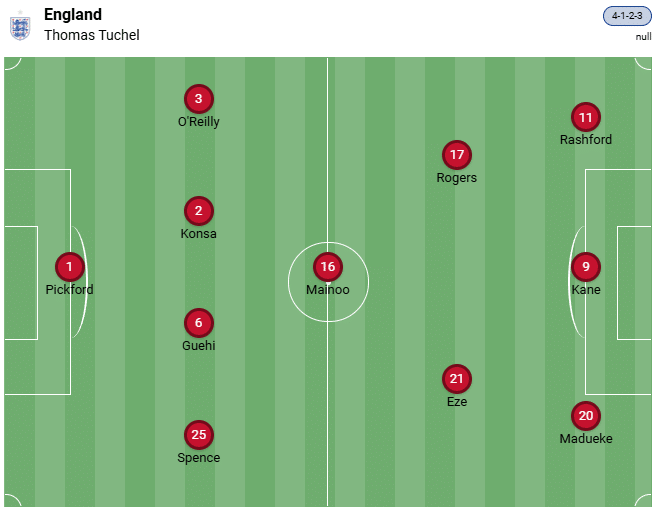
England had controlled Argentina long enough, kept Messi away from the center, and—in the first half of a heated, disjointed match—done exactly what semifinals often demand: suffer, control, wait. After taking the lead, Tuchel made adjustments, bringing in fresh defensive reinforcements to close gaps and strengthen his back line in aerial duels.
A plan that, given the tournament’s previous developments, wasn’t pulled out of thin air. Including the semifinal against La Albiceleste, the Three Lions have conceded no more than 0.08 expected goals per shot on target in this World Cup. This team rarely gives up promising shooting opportunities.
The final stage for the great strikers
For neutral spectators, this match also carries weight because of Harry Kane and Kylian Mbappé. The English captain has played a strong tournament: six goals, big moments, and a lot of responsibility. And yet, a bitter question looms once again: Will he get another realistic chance at a World Cup title?
In 2030, he’ll be 36. Of course, he can look to Messi, who at 39 is still making his mark in a final. But Messi isn’t the standard—he’s an exception. Kane loves the national team, and no one should write him off from this squad. Together with Jude Bellingham, he’s scored 12 of the Three Lions’ 14 goals (six each).
Third-place matches are hard to predict because they depend heavily on motivation, rotation, and emotional state. Coaches often use the match to give playing time to players who haven’t seen much action so far. At the same time, France vs. England, Mbappé vs. Kane, and Deschamps’ final match are too big to be treated entirely as a friendly.
Furthermore, every third-place match at a World Cup since 2014 has featured “Under 3.5 goals.”
France – England Head-to-Head Record
Eight matches have been played between the two soccer nations this millennium. France has won five of those encounters, with only one loss. That leaves two draws—both 1-1. Since 2000, seven of the eight matches have featured three goals or fewer.
France vs. England Prediction
France is likely to try to play more vertically and freely again. Against Spain, the wings were isolated, the center was controlled, and the connections to Mbappé were cut off. Against England, spaces could open up if Tuchel once again defends deep or rotates his lineup heavily.
England, in turn, must decide whether to play more boldly in the wake of the criticism following the semifinal. Against France’s pace, an overly aggressive approach would be risky, but purely defensive play would only repeat the same problems. The best version of the Three Lions in this tournament emerged when Kane, acting as a link-up player, was able to set up runs for Bellingham, Gordon, Saka, or Rogers.
France vs. England isn’t the match these two nations wanted. France wanted to send Deschamps off with a victory in the final. England wanted to finally rewrite history and reach its first World Cup final since 1966. Now, the bronze medal is all that remains.
That sounds like less than it is. For Les Bleus, it’s the last chance to show that the match against Spain was a blip and not the true face of this generation. For England, it’s the chance to end yet another tournament not just with heartbreak, but with a victory. Whether they succeed depends less on major tactical overhauls than on their mindset.

